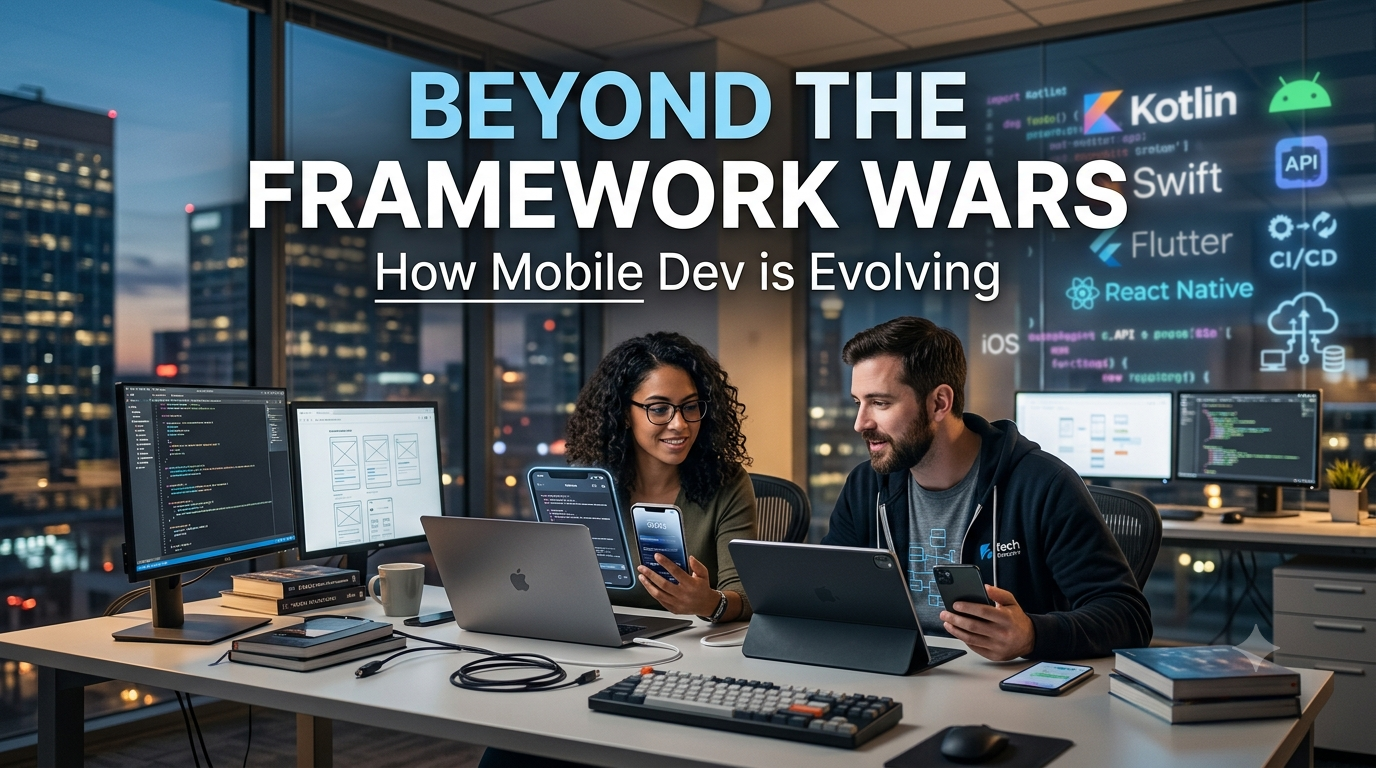
1. Introduction: The Death of the "Either/Or" Debate
The narrative surrounding cross-platform development has been stuck on a loop for years: Flutter vs. React Native. It was treated like a zero-sum turf war, where choosing one meant completely discarding the other.
But as we look at the mobile landscape, the paradigm has shifted. The fundamental capabilities of cross-platform engines have achieved absolute production-grade maturity. The "wars" over basic rendering and execution speeds are practically over. Instead, engineering teams are choosing frameworks based on high-level strategic alignment: Architecture, Developer Experience (DX), and Ecosystem Integration.
2. The Architectural Reset: Under the Hood
To understand why the old debate is dead, we have to look at how both ecosystems fundamentally re-engineered their underlying runtimes to kill performance lag.
React Native: The Bridgeless Reality
For years, React Native’s biggest bottleneck was the asynchronous JavaScript Bridge. Passing serialized JSON data between the JS runtime and the Native threads caused massive performance overhead during rapid events like fast scrolling or heavy animations.
The Shift: The modern Fabric Renderer and JavaScript Interface (JSI) have completely replaced the old bridge architecture.
The Impact: JS can now hold direct references to host objects and invoke native methods synchronously. This multi-threaded execution model has effectively eliminated the lag, delivering smooth 60 FPS interfaces for standard enterprise CRUD applications.
Flutter: Predictable Frame Rates with Impeller
Flutter took the opposite approach to rendering by avoiding platform-native components entirely, drawing every pixel from its own self-contained engine. However, its original engine (Skia) suffered from "shader jank"—unpleasant frame drops the first time an animation loaded because shaders had to compile at runtime.
The Shift: Flutter’s custom-built Impeller engine is now the rock-solid default on both iOS and Android.
The Impact: Impeller pre-compiles all shaders at build time and leverages modern GPU APIs (Metal on iOS, Vulkan on Android) directly. The result is a rock-steady 120 FPS rendering capability on high-refresh-rate displays, slashing average frame rasterization times by nearly 50% under heavy graphic loads.
3. The 2026 Core Paradigm Comparison
When evaluating these stacks for production, technical decision-makers look past syntax popularity and evaluate engineering trade-offs directly.
Engineering Metric | React Native (New Arch) | Flutter (Impeller) |
Architectural Strategy | Orchestrates native platform components via a unified JS/TS layer. | Paints an entirely independent, pixel-perfect UI canvas. |
State Management | Fragmented but hyper-mature (Redux Toolkit, Zustand, MobX). | Highly structured, clean-architecture friendly (Riverpod 3.0, BLoC). |
Initial Binary Footprint | Smaller (approx. 5–8MB base APK) by sharing native system UI libraries. | Larger (approx. 8–12MB base APK) due to bundling its own rendering engine. |
Over-The-Air (OTA) Updates | Built-in capability via Expo EAS to bypass app store review pipelines. | Requires complete app store binary submissions for UI logic updates. |
Code Reuse Beyond Mobile | Good for code-sharing logic with an existing standard React web app. | Best-in-class multi-platform reach (Mobile, Desktop, WebAssembly). |
4. The Third Contender: Logic-Only Share With Kotlin Multiplatform (KMP)
The evolution of mobile dev isn't just cross-platform UI. A fast-growing segment of the industry is pushing back against shared UI altogether, opting instead for Kotlin Multiplatform (KMP).
The KMP Philosophy: Share the complexity, keep the native experience.
Instead of wrapping the interface inside a foreign engine, KMP allows developers to compile shared business logic (networking, local caching, data validation, and DDD domain layers) into a native library for both iOS and Android.
The UI layer remains 100% native—built using Jetpack Compose on Android and SwiftUI on iOS. For teams who refuse to compromise on native system features (like precise iOS bounce physics or Android ripple effects), KMP represents the true evolution of shared codebases.
5. The Real Evolution: AI-Driven & Agentic Workflows
The biggest shift in modern mobile engineering isn't the code execution—it’s how the code is generated. App development is shifting toward Agentic Workflows, changing the developer's role from raw syntax writer to architectural orchestrator.
Scaffolding & Boilerplate: Rather than spending days manually setting up Clean Architecture folder structures, repository layers, and data sources, AI agents inside modern development environments handle the baseline structural setup in seconds.
Context-Aware Coding: Teams are using custom-trained AI agents that understand specific state-management rules (like Riverpod immutability or React hooks) to generate highly predictable, type-safe features based on plain English feature specs.
The Shift in Value: Because AI tools can build out standard feature modules and simple MVPs at unprecedented speeds, a mobile developer's value is no longer tied to how fast they write UI views. Value now lies in masterfully designing scalable systems, domain models, and robust local data layers.
6. Conclusion: How to Choose in the Modern Era
The framework decision is no longer a technical gamble; it is a business strategy alignment test.
Choose React Native if your organization is heavily anchored in the JavaScript/TypeScript ecosystem, you are running an existing React web stack, or your product strategy depends heavily on instant over-the-air (OTA) updates to bypass app store review friction.
Choose Flutter if your application demands custom, high-fidelity UI design systems, complex custom animations, or if you plan to launch across mobile, desktop, and web simultaneously from a single, strongly-typed codebase.
Choose Kotlin Multiplatform if you are building core, data-intensive consumer products where absolute native UI perfection is non-negotiable, but maintaining duplicate networking and data-sync layers across two native teams is financially unviable.
Discussion
Share your thoughts with the CCDevs community.
Comments are visible immediately and moderated for quality.