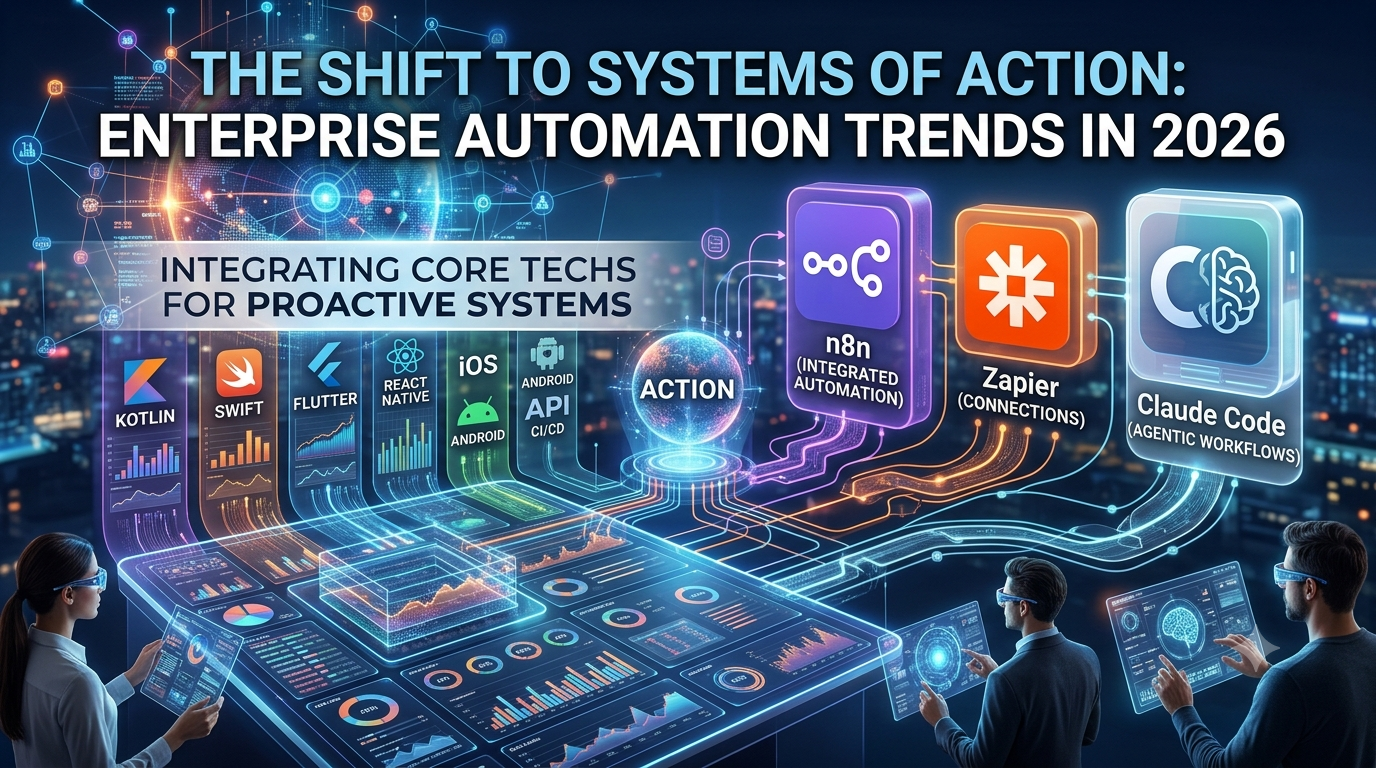
For the past decade, enterprise automation operated on a predictable, linear promise: If This, Then That. It was the era of the passive pipeline. Data moved from System A to System B, synchronized across cloud silos, and triggered rigid, deterministic workflows. These Systems of Record and Systems of Engagement kept organizations connected, but they lacked a crucial element: autonomous agency. They could move information, but they couldn't decide what to do with it if the path diverged by even a fraction.
In 2026, that paradigm has broken down. The modern enterprise is no longer satisfied with plumbing; it demands execution. We are witnessing a massive structural migration toward Systems of Action—environments where automation software doesn't just pass messages, but actively reasons, executes complex toolsets, and self-corrects in real-time.
This shift is driven by a fundamental realization: APIs alone aren't enough when business logic requires dynamic decision-making. The goal is no longer just linking software together, but building an autonomous connective tissue that acts on behalf of the enterprise.
What is New in 2026: The Rise of Agentic AI
The defining trend of 2026 is the transition from passive AI assistants to Agentic AI. Unlike conversational chatbots that require continuous human prompting, agentic systems possess the reasoning capabilities to evaluate context, make independent decisions, and execute multi-step workflows across disjointed software platforms.
According to recent Gartner technology trend reports, organizations have stopped trying to automate everywhere all at once. Instead, the focus has shifted to completing small, end-to-end routine workflows with absolute precision. Rather than just flagging a mismatched invoice, an intelligent agent can now cross-reference the data with your ERP, query the vendor autonomously via email to resolve the discrepancy, and queue the validated transaction for final human approval.
Defining "Systems of Action" vs. Legacy Automation
To understand where enterprise tech is going, we have to look at how the definition of a "workflow" has evolved. Legacy automation was built around deterministic routing. If a customer submitted a refund request, the automation checked a database, sent an email, and updated a spreadsheet. It was fast, but fragile. If the customer's sentiment was highly volatile or the data format changed, the pipeline shattered.
A System of Action fundamentally changes this dynamic by shifting from static sequences to dynamic orchestration.
[Legacy Workflow] ---> Trigger ---> Rigid Step A ---> Rigid Step B ---> End (Fails if unexpected data occurs)
[System of Action] -> Event ---> Contextual Evaluation ---> Dynamic Tool Selection ---> Loop/Self-Correct ---> Execution
To understand what is best and what is coming next, you have to look at how these three tools are redefining automation from different angles.
1. n8n vs. Zapier: The Paradigm Shift in Workflow Automation
Historically, Zapier was the king of simple integrations, while n8n was the open-source, developer-friendly alternative. This year, the divide is no longer just about open-source vs. closed SaaS—it is about deterministic workflows vs. agentic orchestration.
Zapier: The Guided "AI-Assisted" Chain
What it is now: Zapier remains highly accessible, boasting over 9,000 app connectors. However, its pricing model treats every individual action step as a "task," which becomes incredibly expensive when running complex loops.
The Agentic Aspect: Zapier has introduced AI actions and basic "Zapier Agents," but the core system is still fundamentally a linear, predefined trigger-action chain. The AI is a node inside a workflow you built. It struggles when a task branches in unexpected ways.
When to use it: When a non-technical business team needs to quickly connect two mainstream SaaS apps in 5 minutes without writing a single line of code.
n8n: The Multi-Agent Visual Canvas
What it is now: n8n has completely stolen the spotlight for advanced automation by embracing an AI-native node architecture. It features native nodes for LangChain, advanced memory primitives, vector databases (like Pinecone or Supabase), and dedicated AI Agent nodes.
The Agentic Aspect: In n8n, you don't have to wire up every single rigid path. You can drop an AI Agent node on the canvas, hand it "tools" (which are other n8n nodes like Gmail, HubSpot, or custom APIs), and let the LLM dynamically decide which tool to use based on incoming data.
The Huge Advantage: It charges per workflow execution, not per task step. If you self-host it via Docker, it is virtually flat-rate, making high-volume AI loops remarkably cost-effective.
When to use it: When technical teams or advanced automation builders need to design complex, multi-agent business workflows, RAG pipelines, or asynchronous processes with human-in-the-loop approvals.
2. Claude Code: The Developer's Agentic Frontier
Claude Code operates in an entirely different dimension than n8n or Zapier. It isn't a tool for connecting SaaS apps; it is an autonomous, agentic coding environment that lives directly inside your terminal.
What it does: You feed it an objective (e.g., "Refactor this repository to use Riverpod 3.0," or "Build an API endpoint for a new web scraper"). It reads your codebase, writes code, creates files, executes shell commands, runs tests, reads the error logs, and autonomously iterates until the code works perfectly.
How it connects to automation: Inverting the traditional model, tools like Claude Code act as the creator while n8n acts as the operator. Through the Model Context Protocol (MCP), an open-source n8n-MCP server allows a tool like Claude Code to interact directly with n8n. You can literally instruct Claude Code to build and deploy a complex lead-qualification workflow straight into your n8n instance.
When to use it: Exclusively for software engineers and developers who want to move 10x faster when building custom backend logic, infrastructure scripts, or bespoke codebases.
3. What is Coming Next?
The future of this space is the complete inversion of traditional software design. Instead of a human drawing a flowchart on a canvas (like Zapier or classic n8n), you will simply specify a high-level business goal or state your operational intent.
The orchestration layer will dynamically spin up specialized sub-agents, synthesize its own temporary mini-workflows on the fly, execute the necessary API calls, self-correct if an endpoint fails, and present a finished result for human verification. Enterprise automation is rapidly shifting from a tool you carefully instruct to an autonomous teammate you manage.
📺 Deepen Your Understanding
If you want to see exactly how this paradigm shift looks in action, check out this guide on switching from traditional n8n workflows to agentic workflows with Claude Code. This video provides a direct, hands-on demonstration of how describing a desired outcome to an AI agent compares to manually wiring up individual nodes, highlighting exactly when to use each approach.
Conclusion: The Missing Link in the Automation Narrative
When discussing the automation space, many industry analyses make a critical mistake: they treat the technology as a race toward complete human exclusion.
The most vital, often-overlooked trend of 2026 is that true competitive advantage is no longer defined by what a company builds, but by how intelligently it orchestrates human and AI talent together. The companies winning this year are not firing their staff to save pennies; they are leveraging agentic workflows to eliminate operational friction, liberating their human workforce to innovate, build client relationships, and drive genuine corporate growth.
Automation is no longer just a tool for saving time—it is your organization's ultimate lever for long-term operational resilience.
Discussion
Share your thoughts with the CCDevs community.
Comments are visible immediately and moderated for quality.